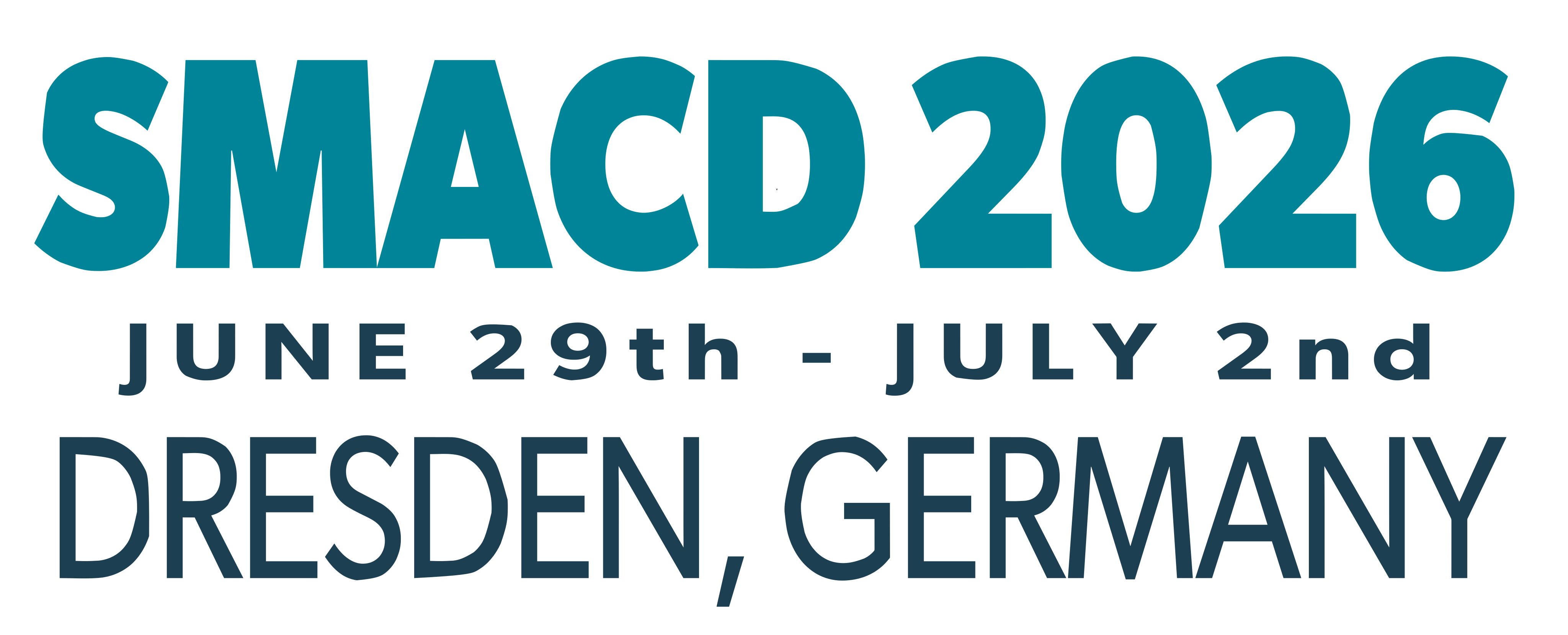










2026 Information
Date
June 29th - July 2nd 2026
Location
Hilton Dresden – An d. Frauenkirche 5, 01067, Dresden, Germany
Organized By

Our Sponsors
Silver Sponsers
Bronze Sponser
Technical Sponsors
Competition Sponsors
Organized By
Paper Guidelines & Submission
General Information
The working language for SMACD is English, used for all presentations and printed materials. SMACD will only accept electronic submissions in PDF format.
Paper Specifications (Max. 4 pages)
- Paper Length: Maximum of 4 pages , including figures, tables, and references. Documents exceeding this limit will be automatically rejected.
- Paper Size: Only US Letter (8.5″ × 11″) or A4 (210 mm × 297 mm) formats are accepted.
- Paper Format: Authors must follow IEEE double-column conference paper template .
- File Size: PDF files should not exceed 2.0 MB.
Reviewing Process
Papers submitted for review must clearly state:
- The purpose of the work
- How and to what extent it advances the state-of-the-art
- Specific new results and their impact
Submitted papers undergo a single-blind review process, i.e. author identities may remain visible in the manuscript. The degree to which the paper addresses these criteria will affect the selection process. The most common reason for rejection is the lack of new results. Only work not previously published will be considered.
Submission of a paper for review and subsequent acceptance implies the authors agree that the work will not be made public before the conference.
Notification
Submitted papers will be peer reviewed by competent reviewers selected by the international Technical Program Committee . Accepted papers will be included in the conference proceedings, which will be published in IEEE Xplore.
After review, authors will be notified of the decision by the Technical Program Committee via email.
Call for Tutorials & Special Sessions
Proposals should be made to the Tutorials & Special Sessions Chair:
Ralf Sommer (Ralf.Sommer@tu-ilmenau.de)
Tutorials
The SMACD 2026 organizing team invites researchers and professionals in the areas of the conference to propose tutorials to be held in this year's edition.
Tutorials allow participants to explore innovative trends and learn new techniques from experts on specific topics. SMACD solicits proposals for tutorials of 90 minutes (although tutorials of 180 minutes in 2 blocks of 90 minutes may be considered).
Tutorial proposers should provide the following information:
- Title and Brief Description of the Tutorial
- Name(s) and Short Bio(s) of the presenter(s)
- Approved Tutorial presenters are strongly encouraged to submit a 4-page (IEEE Xplore-compatible) invited paper to accompany the tutorial.
Tutorial proposal deadline: March 20th 2026
Special Sessions
Special sessions provide the opportunity to focus in detail on emerging topics that are not reflected in the list of conference tracks or represent a specific working field where researchers would like to meet and discuss advances.
Special session proposers should provide the following information to the Tutorials & Special Sessions Chair: :
- Title of the Special Session
- Brief description of the Special Session (with particular focus on why this is an exciting and significant topic)
- Names and affiliations of the special session organizers
- A list of at least 5 contributed papers with authors, affiliations, and tentative paper titles
Special Session paper submission deadline: March 13th 2026
EDA Competition
Compete for The $1000 and Join the Hall of Fame
As usual in SMACD Conferences, the 2026 edition, which will take place in Dresden, Germany, from the 29th of June to the 2nd of July, will also hold a thrilling and dynamic event where M.Sc. and Ph.D. students can compete with their best ideas, methodologies, flows, and tools with one unique yet challenging goal:
Enhance Design Automation for Integrated Circuits and Systems
The winner(s) of the event will receive a prize of $1,000.
How to Enter the Competition?
All participants must submit a paper (following the same SMACD 2026 submission guidelines) with a description of the methodology and/or tool, the design problem of their choice, and the solution provided by their methodology and/or tool. The first author of the submission and presenter at the conference must be a MS.c. or a Ph.D. student!
Evaluation Criteria
A Judging Committee will select the winner(s) based on the quality of the paper, its presentation at the conference, and the live demonstration, using the following criteria:
- Complexity of the problem posed in the paper.
- Level of automation (e.g., fully automated, user-assisted, etc.);
- Designer interface (e.g., problem setup, result analysis, etc.);
- Applicability of the proposal (e.g., general approach or restricted to special problems, circuit classes or sizes, etc.);
- Robustness of the design solutions (e.g., against parasitics, variability, etc.) and of the proposal itself (e.g. convergence, insensitivity to input and starting values, etc.);
- Integration degree with commercial design suites and design methodologies (e.g., import and export data from these suites, usability in one or more steps of current design flows, etc.);
Topics of Interest
Methodologies and tools related to all topics of the SMACD26 conference (e.g., Synthesis, Sizing, Optimization, Modeling and Simulation of AMS, RF, and multidomain circuits, ML and Cloud Computing EDA methodologies, EDA methodologies for Hardware Security and Emerging Devices, etc.).
Important Notes
- All accepted submissions in the competition will be presented by the students in special sessions and published in the conference proceedings;
- The presenters must perform a live demo of the methodologies/tools;
- SMACD organization guarantees internet connection to all participants, but required CAD tools or design kits licensing are the responsibility of each participant;
- Papers not accepted for the competition short-list will still be considered by the technical program committee for the SMACD 2026 regular sessions.
IC Design Contest
Compete for The $1000 and Join the Hall of Fame
The 2026 edition of the SMACD Conference, which will take place in Dresden, Germany, from the 29th of June to the 2nd of July, will also hold a thrilling and dynamic event where M.Sc. and Ph.D. students can compete with their best use of EDA methodologies, to reach one unique yet challenging goal:
Enhance Integrated Circuits and Systems
The winner(s) of the event will receive a prize of $1,000. The prize is sponsored by:
How to Enter the Competition?
participants must submit a paper (following SMACD 2026 submission guidelines) that fits into one or more of the following categories:
- Novel IC designs whose performances compete within the state-of-the-art of its research field (at least including Post-Layout simulations);
- IC designs where at least one step of its development flow was partially (or fully) assisted by custom/academic Computer-Aided Design and/or Electronic Design Automation tools;
- IC designs clearly identifying one or more steps of the development flow that would greatly benefit from the development of new Computer-Aided Design and/or Electronic Design Automation tools;
- The layout of the circuit must be present and a prototype test is considered an added value. The first author of the submission and presenter at the conference must be a MSc or a PhD student!
Evaluation Criteria
A Judging Committee will select the winner(s) based on the quality of the paper, the presentation at the conference, and the Q&A during the special session, using the following criteria:
- Complexity of the problem posed in the paper;
- Level of EDA support to reach the presented IC design;
- Robustness of the design solutions (e.g., against parasitics, variability, etc.).
Topics of Interest
IC designs resulting or enhanced by EDA methodologies and tools related to all application topics of the SMACD26, e.g., AMS, RF and multidomain circuits, and also, emerging devices.
Important Notes
All accepted submissions in the IC Design Contest will be presented by the students in special sessions and published in the conference proceedings.
Papers not accepted for the contest short-list will still be considered by the technical program committee for the SMACD 2026 regular sessions.
SMACD 2026 Sponsor Packages
Bronze Sponsor — 1000 €
- A full registration for 1 person
- Inclusion of the company logo on the conference website and conference materials
- Acknowledgment by the General Chairs during the Opening and Closing Ceremonies
Silver Sponsor — 2500 €
- A full registration for 2 persons
- Inclusion of the company logo on the conference website and conference materials
- Reference to the sponsorship of a coffee break
- Acknowledgment by the General Chairs during the Opening and Closing Ceremonies
- A technical presentation (10’) at the Industrial Session
Gold Sponsor — 5000 €
- A full registration for 3 persons
- Inclusion of the company logo on the conference website and conference materials
- Reference to the sponsorship of at least one coffee break
- Acknowledgment by the General Chairs during the Opening and Closing Ceremonies
- A technical presentation (20’) at the Industrial Session
Steering Committee
Francisco V. Fernandez
IMSE-CNM, University of Seville and CSIC, ESGünhan Dündar
Boğaziçi University, TRNuno Lourenço
IT, PTRalf Sommer
IMMS GmbH & TU Ilmenau, DEGiulia Di Capua
University of Cassino and Southern Lazio, ITNuno Horta
IT and University of Lisbon, PTRafael Castro López
IMSE-CNM, University of Seville and CSIC, ESRicardo Martins
IT and University of Lisbon, PTNestor Evmorfopoulos
University of Thessaly, GreeceEngin Afacan
Gebze Technical University, TROrganizing Committee
General Chair
Benjamin Prautsch
Fraunhofer IIS, Dresden, DETPC Chairs
Günhan Dündar
Boğaziçi University, TRNuno Horta
IT and University of Lisbon, PTRicardo Martins
Instituto Superior Técnico, PTFrancisco V. Fernandez
IMSE-CNM, ESPublication Chairs
Fabio Passos
IST - University of Lisbon and INESC-ID, PTRafael Castro-López
IMSE-CNM, ESPublicity Chairs
Giulia Di Capua
University of Cassino and Southern Lazio, ITPaula Hartmann
Fraunhofer IIS, Dresden, DEEDA Competition Chair
Andreas Krinke
TU Dresden, DEIC Design Competition Chair
Björn Zeugmann
Fraunhofer IIS, Dresden, DETutorial & Special Session Chair
Ralf Sommer
TU Ilmenau, DEIndustrial Liaison Chairs
Ngoc Ha Doan
Fraunhofer IIS, Dresden, DEKatja Lohmann-Schwitale
Fraunhofer IIS, Dresden, DEContact
For any inquiries regarding the SMACD 2026 Conference, please feel free to reach out to the conference chair or the organizing team.
Conference Chair: benjamin.prautsch@iis.fraunhofer.de
General Inquiries: info@smacd-conference.org
We look forward to hearing from you and are happy to assist with any questions or concerns regarding the conference.